


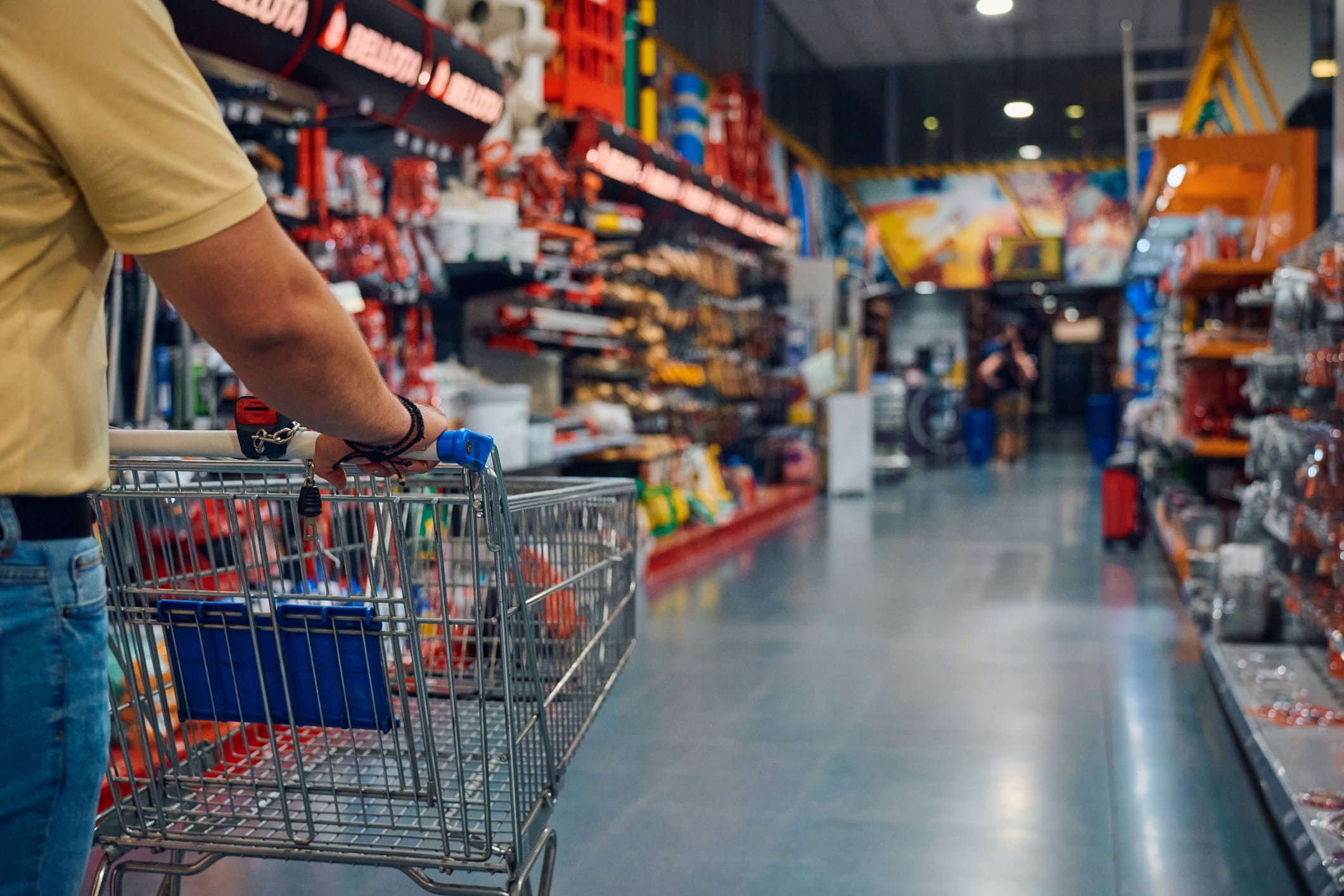
Quo vadis, DIY?
Up until recently, the (German) DIY sector could still tell itself a reassuring story: the pandemic created distortions, consumers turned cautious, inflation hit households, and growth would normalise once demand recovered. We believe German DIY is not simply working through a cyclical dip. It is entering a structurally more demanding phase – one in which legacy strengths such as large-box scale, broad assortments and dense physical presence no longer translate automatically into attractive economics.
The industry may be moving from temporary pressure to permanent redesign, making strategy more important than ever.
This is no longer just a demand issue
DIY players are feeling the real impact of short-term pressures. Consumer spend has shifted more towards experience and leisure, and away from physical goods. Online players continue to take share (TEMU, Mano Mano, Otto). Discounters and value formats are becoming more relevant across DIY (Sonderpreis Baumarkt, LIDL / Parkside, Action). Labour and operating costs continue to increase and put pressure on already thin retailer margins.
Most management teams are already responding. However, even with many of the right strategies in play, the underlying economics of the market remain under strain – suggesting the issue runs deeper than the cycle.
Germany is still comparatively fragmented; Capacity remains high, sales densities are under pressure, and profitability is thin. In this market, improvement will not come from waiting for demand to repair the model – it will come from reshaping the model so that it works in a lower-growth environment.
The next phase of German DIY will be defined by five realities
What matters now is not a long list of symptoms, but a handful of strategic realities that are becoming harder to avoid:
Operational complexity has become expensive. Too much assortment & choice (breadth), too many process layers and little simplification are weighing on productivity across the (brick & mortar) core business.
B2C vs. trade is becoming a sharper strategic divide. The more attractive unit economics increasingly sit with trade and professional customers, where basket size, frequency and loyalty are structurally stronger.
Big-box DIY remains relevant, but no longer beyond question. Large formats will continue to matter, yet not every site, catchment or format logic deserves to be preserved unchanged. New, smaller formats may evolve to address customers that are looking for more convenient (i.e. nearer) location and / or proposition.
Germany increasingly becomes a share battle, not a growth market. In a market with limited structural growth, strategy becomes less forgiving: one player’s upside is increasingly another player’s loss. Growth opportunities lie beyond German borders.
Margin pools beyond the shelf are moving closer to the centre of the value creation case. Services, retail media, marketplaces and adjacent models are no longer peripheral opportunities; they are becoming part of the future economics of the sector.
None of this will feel entirely new to industry leaders, but these realities are becoming more consequential, more urgent, and harder to postpone.
The diy industry is moving – but the bar is rising faster
Many leading players are already acting on these themes. They are simplifying assortments, sharpening own brand, strengthening trade propositions, improving digital journeys, revisiting portfolios and testing new service or monetisation models.
That is encouraging, but it also raises the strategic bar.
The question is no longer whether retailers have recognised the pressure. It is whether their response is bold enough for the scale of structural change underway.
Incremental action may improve performance at the margin. It is less likely to redefine competitive position.
The New Winners in DIY Retail
The German DIY is undergoing an evolution – as is the market. Competitive pressure is broadening, economics are tightening and the cost of half-measures is rising. There are significant opportunities in this market, though they will not accrue evenly.
The winners in the next phase will be those that use today’s pressure to simplify faster, focus harder and move earlier than the market forces them to.
For more insights, read our full report below.
Artigos sugeridos
Ver todos os artigos
quinta-feira 24th setembro 2026
Textile EPR in Europe: Why Fashion Needs to Prepare Now
Europe’s approach to textile waste is changing. Under a revised EU Waste Framework Directive, responsibility for the end of a product’s life is shifting...
segunda-feira 14th setembro 2026
Widening the Launch Window: Reigniting the Investment Thesis in European Foodservice
At a recent breakfast we hosted in partnership with Goldman Sachs, we brought together leading European private equity investors to discuss a simple question:...
sexta-feira 26th junho 2026
AI does not create success – but it amplifies what is creating success: Resilience and Relevance
OC&C partners joined retail industry leaders at the 2025 K5 Future Retail Conference, to explore the forces shaping retail and how leaders can navigate...
quinta-feira 11th junho 2026
The New Luxury Equation: from Awareness to Desirability
A more mature luxury market is reshaping the industry's outlook. While growth can no longer be taken for granted, discussions at the RLC Fashion...
sexta-feira 8th maio 2026