


Food Supply Chain Resilience: Redesigning Food Logistics Strategy for a Volatile World
For three decades, the food industry perfected cost efficiency. Global sourcing, lean inventories, centralised production and just-in-time replenishment drove margin expansion and predictable service levels. Logistics was operational, volatility was manageable and scale delivered an advantage. That paradigm has now expired.
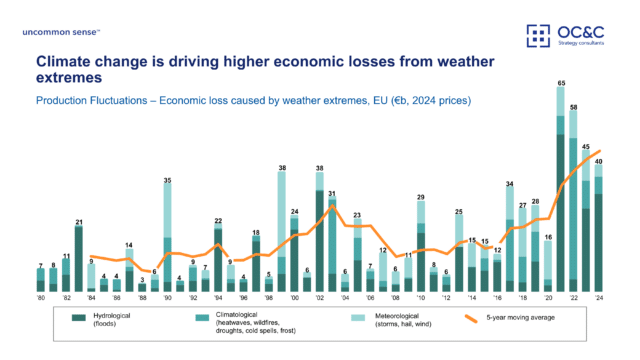
Structural volatility in the food industry has permanently altered the economics of supply. Climate disruption, disease outbreaks, geopolitical fragmentation, trade intervention, cyber risk and freight instability are no longer episodic shocks and have fundamentally altered the risk profile of food supply chains. What was once considered an operational issue has become a board-level strategic concern.
Boards must now rethink food logistics strategy not as a cost function, but as a control lever within increasingly fragile food value chains. The next decade will belong to organisations that deliberately redesign their supply chains for resilience rather than pure efficiency. We see 4 key trends that will change the setup of food supply chains at a rapid pace and present our key strategic imperatives for the next decade.
Structural Volatility in the Food Industry Is Rewriting Supply Chain Economics
Volatility is no longer cyclical, it is structural. Agricultural output is less predictable across the board, from managing extreme weather to disease outbreaks which remove supply in weeks. Consumer demand is shifting faster than traditional forecasting cycles can absorb. Trade disputes and infrastructure cyberattacks introduce additional fragility which previous generations did not have to address.
This sustained supply chain volatility in the food industry has profound implications. Lead times are less reliable, input costs fluctuate more sharply, and service levels are harder to guarantee. Across the sector, the response has been visible; a structural shift from “just-in-time” to “just-in-case”.
“Just-in-case” planning sees inventory buffers increasing, safety stock levels rising and working capital intensity structurally resetting upwards.
But higher stock levels come at a cost:
- Margin pressure from waste, expediting and duplication
- Greater complexity in governance and planning
- Shorter production runs and more frequent changeovers
- Increased reliance on external partners
- A permanent step-up in working capital
For perishable, capacity-constrained and globally exposed categories, the impact is particularly acute. The question is no longer whether volatility will continue, but how your operating model absorbs it.
Proximity vs Cost: Rethinking Food Supply Chain Design
For decades footprint decisions were governed by unit cost optimisation, whilst production was concentrated in regions offering labour efficiency and scale advantages. Distribution networks were engineered to minimise cost per pallet.
That logic is now under pressure.
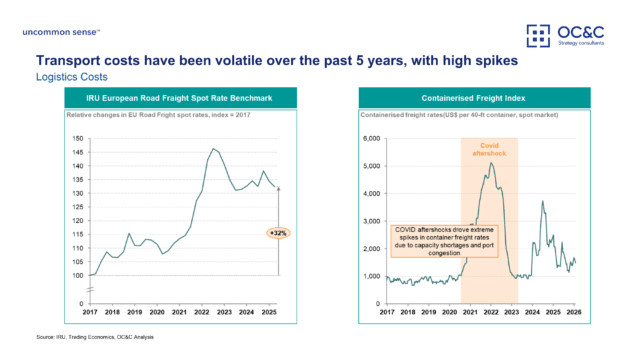
Transport volatility, cross-border friction and geopolitical risk have exposed the fragility of globally optimised networks. Meanwhile retailers, foodservice operators and consumers demand shorter lead times and higher freshness.
Distance has become a Strategic variable
As volatility increases, proximity becomes a resilience lever for providers who can offer:
- Shorter lead times
- Faster response to demand swings
- Reduced category exposure to geopolitical friction
- Lower disruption contagion
This is why we increasingly observe production capacity expanding outside traditional low-cost hubs and closer to demand centres. In categories such as frozen potato products, historically concentrated in established “belts,” capacity is being added in new regions—not because they are always cheaper, but because they are closer.
This shift is not binary. We see large food producers adopt different strategies, with some choosing centralised hubs for scale economics and others prioritising re regional production for responsiveness. Lastly, we see a rise of contract manufacturing to allow for the best of both worlds: scale and proximity
BALANCING COST EFFICIENCY AND RESILIENT FOOD SUPPLY CHAINS
Centralised inventory minimises holding costs. Downstream positioning increases responsiveness and service security. Each additional node introduces cost dispersion but reduces fragility.

In-house vs. outsourced logistics: The Scale illusion
Rising volatility is challenging traditional insourced logistics models. Historically, owning warehouses and fleets delivered control and cost efficiency, provided utilisation remained high and stable. That assumption is weakening. Three structural pressures are converging:
Capital Intensity Is Rising
Land scarcity in core markets, higher construction costs and increased technical specifications are driving up upfront investment. Higher interest rates amplify the burden.
Utilisation Is Harder to Guarantee
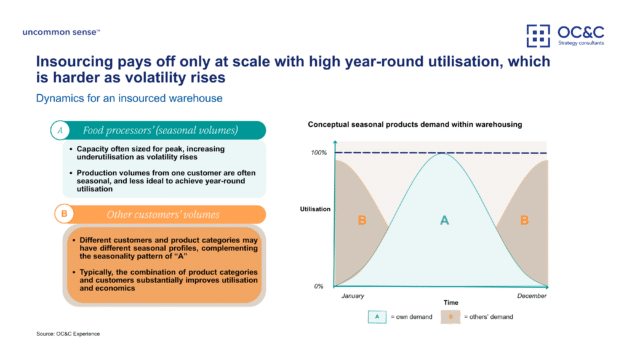
Seasonal and volatile volumes mean assets are sized for peak but underutilised off-peak. Idle capacity destroys returns, outsourced models pool volumes across customers, smoothing utilisation.
Complexity Is Increasing
The economic case for insourcing partly depends on sustained, stable, high volumes. Many businesses overestimate how consistently they meet that threshold.
Complexity in operational scale
The operational scale of complexity is vast, from advanced automation to data integration, both underwritten by compliance requirements and cybersecurity demands. All of these innovations require specialised capabilities that are difficult to replicate in-house without scale.
However, highly automated storage, integrated warehouse management systems, real-time flow orchestration, and advanced analytics are no longer futuristic but now operational realities at scale.
When deployed appropriately, tech-enabled logistics delivers:
- Higher reliability
- Fewer handling errors
- Lower labour dependency amid structural shortages
- Greater storage density and energy efficiency
- Real-time transparency and faster issue resolution
But the model is capital-intensive and requires scale, uptime discipline and specialised expertise. It also increases exposure to system failures and cyber risk if not governed properly.
The extent to which you outsource which step in the value chain is not evident either. A 3rd party logistics provider can optimise over various value chains: combining transport, optimising warehouse utilisation, and with full transparency can probably forecast volume demand and the backward effect on production output better.
Making a model work where you rely much more on your logistics partner is embedded in trust; genuine trust that the 3rd party will meet your standards and will let you benefit from the cost advantages.
logistics as a Competitive Advantage in food value chains
Historically, logistics reliability sat below the executive radar. Delays were absorbed operationally and service issues were episodic. Today, logistics is no longer a back-office function.
Missed deliveries translate directly to retailer penalties and lost shelf space, impacting access to promotional conversion and increased erosion across net promoter scores.
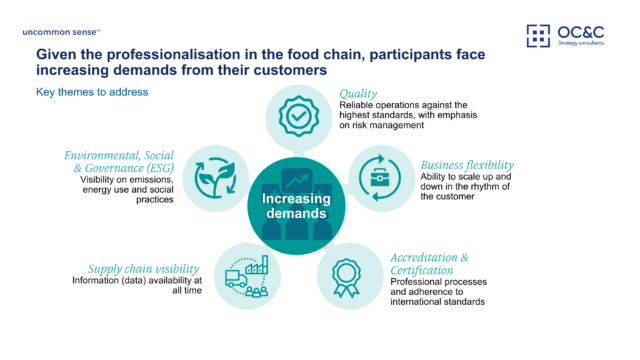
Retailers are demanding real-time visibility, ESG transparency and guaranteed service levels whilst consumers expect availability as standard. In our new standardised, omnichannel environment logistics performance directly enables revenue growth and margin protection by effectively servicing consumers’ shifting expectations across availability, promotions and credible sustainability claims.
cold chain integrity and brand protection
Cold chain integrity is not merely operational compliance. It protects product quality, consumer trust and long-term brand equity. Failures can no longer be treated as isolated incidents as their impact can be public. Cold chain integrity protects brand equity for all players.
omnichannel fulfilment and revenue protection
In this context, food logistics strategy becomes a revenue enabler, with players who optimise for peak readiness driving promotional success. Inventory accuracy protects working capital whilst reliable stock replenishment safeguards market share.
If logistics fails, growth fails. Boards are increasingly recognising this. The strategic implication is profound: logistics governance, capability and investment must align with commercial ambition.
Our Strategic Imperatives – Designing Resilient Food Supply Chains for the Next Decade
Food value chains are consolidating, globalising and becoming more complex, while structural cost inflation persists. The operating environment is less predictable than at any point in recent decades.
In this context, five imperatives stand out:
- Accept that volatility is structural and design accordingly.
- Rebalance footprint decisions towards proximity and resilience.
- Re-evaluate insourcing assumptions under realistic utilisation scenarios.
- Elevate logistics governance to board-level oversight.
- Invest directly or through partners in automation and digital capabilities that will soon become baseline.
The competitive gap between leaders and laggards will widen.
In the coming decade, advantage in the food industry will not be determined solely by brand strength or product innovation. It will be determined by who controls their supply chain under stress.
The era of logistics as a quiet cost centre is over. The next decade belongs to those who redesign it deliberately, with our experts available to support you at every stage of your transformation.
Get in contact using the button below or email [email protected].
Suggested articles
View all articles
Monday 14th September 2026
Pick, Pack and Protect the Brand: Winning in eCommerce Fulfilment
Mid-sized, independent, online-first brands make attractive customers, and are underserved by the shape of the market today. There is an opportunity to offer a...Wednesday 2nd September 2026
Pick, Pack and Protect the Brand: Winning in eCommerce Fulfilment
Mid-sized, independent, online-first brands make attractive customers, and are underserved by the shape of the market today. There is an opportunity to offer a...
Monday 30th March 2026
UK Driving Services: Trends Shaping a £290bn Market
The UK Driving Services market is a large, resilient and evolving ecosystem worth ~£285–290bn, supported by high driver engagement and the continued importance of...
Monday 9th March 2026
How to Build a Fireproof Business
The fire safety space has attracted significant investment of late as investors recognise the merits of a large, resilient market underpinned by regulation, robust...
Monday 25th August 2025