


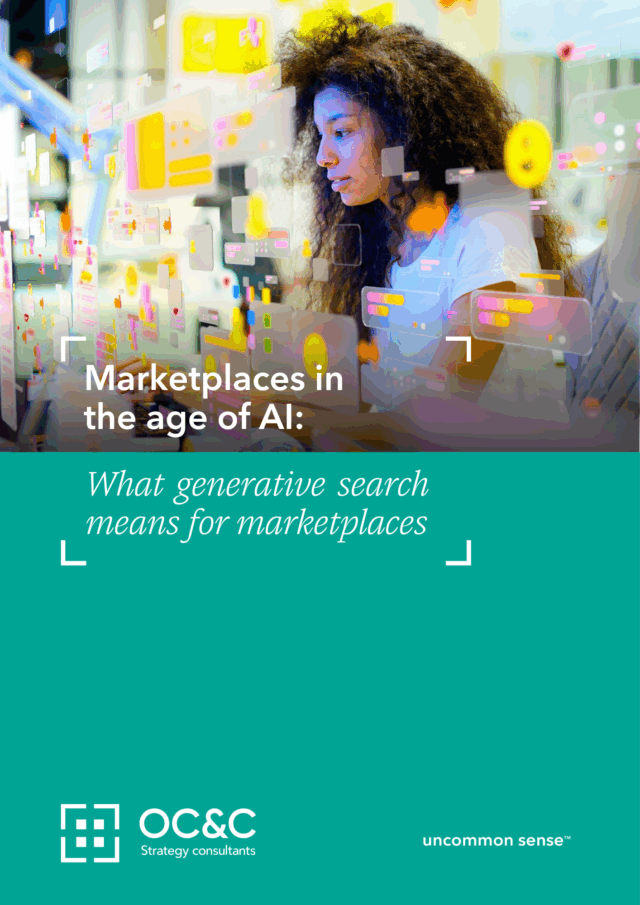
Marketplaces in the Age of AI: What Generative Search Means for Marketplaces
Online marketplaces have long served as the backbone of digital commerce, aggregating supply and demand, enabling comparison and trust, and simplifying complex consumer missions. Today they account for almost half of global online GMV (ex-China) and continue to grow at about 10 per cent annually, with Europe alone projected to add $300 billion in third-party marketplace spend by 2030.
Yet marketplaces now face the most significant disruption since the arrival of the internet: generative AI. With search behaviour shifting rapidly towards conversational, intent-driven interfaces, the foundations of marketplace traffic, discovery and conversion are being rewritten.
Our annual Marketplaces report paints a clear picture: disruption is accelerating, competitive dynamics are changing, and the winners will be those who rapidly adapt their propositions, deepen integration with AI-lab ecosystems, and strengthen defensibility across their categories.
A Structural Shift: How Generative AI Is Transforming Search and Consumer Behaviour
For more than two decades, keyword-led search has shaped how consumers discover products and services. Marketplaces benefited enormously from this era, building scale through SEO, performance marketing and on-site comparison experiences.
Generative AI now introduces a step-change:
Conversational intent replaces keyword search
Consumers increasingly submit natural-language missions rather than predefined search terms, from “Find me a professional summer work wardrobe for £750” to “Plan a three-day trip to Lisbon next weekend”.
This shift changes how demand is routed, compresses traditional funnels, and challenges marketplace visibility at the top of the journey.
Agent-led journeys expand rapidly
Generative search already sees up to 1 billion prompts, growing at more than 20 per cent month-on-month. ChatGPT alone has reached around 365 billion annual search equivalents within two years – a scale that took Google over a decade to achieve.
As AI agents extend deeper into consumer journeys, from discovery to evaluation and eventually to purchase, marketplaces face both disintermediation risk and new pathways to value creation.
The Top-of-Funnel Challenge
Only a small share of purchases currently complete within AI assistants, but a much greater share of early-stage exploration has already shifted upstream into agent environments. This compresses traditional routes to acquisition and reduces the volume of blue-link results surfaced to consumers.
Marketplaces therefore face three specific risks:
- Reduced visibility as agents present synthesised recommendations instead of listings
- Higher acquisition costs as traditional SEO and performance-marketing levers weaken
- Less influence over early consideration if AI agents shape preferences before the consumer reaches the platform
To mitigate this, marketplaces must:
- Optimise content for natural-language discovery
- Strengthen AEO/GEO readiness
- Improve personalisation for “AI-pre-qualified” visitors
- Build more resilient direct-traffic channels (apps, loyalty, CRM, first-party data)
- Enhance seller data quality to ensure strong representation within AI ecosystems
The Opportunity: AI-Enhanced Experiences and Operational Uplift
Generative AI also enables marketplaces to accelerate differentiation and unlock new value pools.
Enhanced customer journeys
AI improves buyer experiences through:
- Conversational queries and smart summarisation
- Visual search and aesthetic matching
- Tailored recommendations
- Predictive analytics on price and availability
- Automated itinerary or workflow assembly
- Deep personalisation across all touchpoints
Leading marketplaces are already deploying AI for discovery tools, seller listing automation, dynamic pricing, fraud detection, review summarisation and conversational commerce.
Improved seller workflows
AI frees sellers from operational friction, automating listing creation, stock forecasting, customer messaging and dispute management. This reduces operating cost and increases supply-side quality, improving conversion for the marketplace as a whole.
New category propositions
AI-native challengers are reshaping entire verticals. In travel, conversational planning platforms allow users to assemble and book complete itineraries in a single interaction, and similar AI-led models are emerging in electronics, home services and other complex, high-friction categories. This signals a future in which agents are increasingly used as the starting point for discovery and decision making.
Marketplaces cannot afford to watch from the sidelines while competitors and AI natives experiment and scale. Momentum in this space will compound quickly, and those that delay risk being overtaken as new models accelerate. The imperative for marketplaces is to act quickly by testing, partnering and evolving propositions now, to shape a defensible place in the agent-led ecosystem, rather than reacting when the market has moved on.
Integration with AI Labs: The New Competitive Battleground
Generative AI relies on structured access to data, tools and APIs. Marketplaces must now decide how deeply to integrate with AI-lab ecosystems. There are five core integration models, ranging from surface-level portal scraping to full agent-to-agent execution most likely via MCP (Model Context Protocol) and ACP (Agentic Communication Protocol).
Why MCP and ACP matter
MCP offers marketplaces a standard way to expose product search, inventory access, valuations and transaction functionality directly within AI-agent environments. This creates new opportunities – but also new dependencies.
Early movers are likely to secure preferential visibility; those who delay may lose distribution, relevance and bargaining power.
APC extends integration further by enabling direct agent-to-agent interaction between consumer AI assistants and marketplace AI agents. Rather than exposing functionality within an AI interface, ACP allows marketplaces to retain control of execution, managing inventory checks, valuations, workflows and transactions on behalf of the user.
This preserves a meaningful role for marketplaces, even as discovery shifts off-platform. However, the strategic risks are high; marketplaces that move early can define standards, secure privileged relationships and embed themselves in the heart of agent-led journeys, while those that hesitate risk being reduce to passive data providers as AI systems consolidate.
For many partnering appears to be the right option, but marketplaces must decide how much of the consumer journey and proprietary data to hand over to AI Labs in return for traffic.
Defensibility: Understanding Where Marketplaces Are Most at Risk
AI expands the potential for disintermediation, but the degree of risk varies dramatically by category.
Our 2025 Marketplaces Report addresses three critical questions when assessing exposure:
- Can AI labs offer a meaningfully better discovery or decision experience today?
- High-complexity, high-stakes or highly personal missions create more risk.
- How easily and effectively can the category’s supply be integrated?
- Standardised or widely duplicated catalogues are most vulnerable; unique or high-friction supply is more defensible.
- How likely are AI labs to prioritise the vertical
Profit pools, consumer-intent frequency and strategic adjacency dictate investment focus.
Categories such as travel, where journeys are complex and data structured, are more exposed; fashion, with stronger visual preference and taste-driven selection, remains more defensible.
Five Priorities for Marketplaces Preparing for an AI-Centric Future
We have identified five strategic priorities that will define the next generation of winners:
1. Evolve the proposition beyond discovery
Use AI to reduce friction across search, evaluation, transaction and aftercare.
2. Expand into AI-enabled adjacencies
Move upstream (planning, configuration) and downstream (fulfilment, issue resolution) to increase stickiness.
3. Define a clear strategy for working with AI labs
Determine which parts of the journey should remain on-platform versus orchestrated through agents.
4. Manage downside risk through defensibility
Strengthen exclusive supply, data assets, fulfilment capabilities and trust layers.
5. Raise tactical readiness
Improve structured content, natural-language visibility, AEO/GEO optimisation and direct-traffic levers.
Investor Perspective: What Makes a Marketplace Asset Attractive in the AI Era?
The report identifies three types of assets that will attract investor attention:
- Forward-thinking incumbents already deploying AI across journeys and operations
- AI-native challengers built on agentic workflows and reimagined user journeys
- B2B enablers offering infrastructure, data or vertical tools that accelerate AI adoption across marketplaces
These profiles point to a future where both scaled platforms and innovative disruptors can outperform — provided they adapt early.
For more insight, read our full report below.
Contact our expert team for more information.
Key Contacts

Caitlin Bailey-Williams
Associate Partner

Zee Ashraf
Partner

Toby Chapman
Partner
Suggested reports
View all reports
Tuesday 10th February 2026
Private Equity Transactions 2025
Explore sector insights, key highlights from the successful deals we supported across our core specialisms in 2025, and a glimpse into what 2026 holds.
Monday 24th November 2025
Driving Value Creation in Private Equity
Private equity is at a turning point. Fundraising has slowed, exits are bottlenecked, and financial-engineering tailwinds are fading. But opportunity remains for those who...
Friday 24th October 2025
Navigating the Rise of AI in Marketing: From Hype to Impact
Marketing has always evolved through waves of technological change, from the dominance of mass media to the performance era of digital. Artificial intelligence now...
Wednesday 29th January 2025
Private Equity Transactions 2024
Explore sector insights, key highlights from the successful deals we supported across our core specialisms in 2024, and a glimpse into what 2025 holds...
Wednesday 22nd May 2024