


Pockets of Growth in European Beverages: Where Leaders Are Winning in a Low-Growth Market
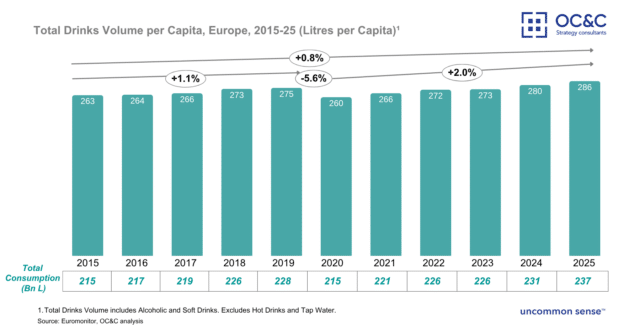
Across Europe the beverages sector presents a paradox. At a headline level, growth appears modest with per capita consumption having increased only slightly over the past decade, rising from approximately 215 litres in 2015 to 237 litres in 2025. Beneath this surface, however, the category is undergoing profound structural change. For leaders the implication is clear, growth is no longer linear or evenly distributed, but instead must be actively captured.
A market shaped by structural shifts
Four macro forces are redefining how beverages are consumed across Europe.
- Health and wellness has transcended niche consumer bases and is now the mainstream. Around 60% of consumers now prioritise “ageing well” more than they did five years ago, while regulatory pressure on sugar and alcohol has intensified across major markets. This is not a passing trend but a fundamental reset of consumer expectations.
- Our social habits are evolving with 75% of Millennials and Gen Z consumers’ reporting moderating their alcohol intake. This shift is reshaping demand patterns, particularly within traditional alcohol categories.
- Route-to-market dynamics are changing. The closure of roughly 100,000 pubs and bars across key European countries over the past decade has altered consumption occasions and accelerated the importance of retail and at-home formats.
- Choice is fragmenting. New product development has increased by 20–25% in recent years, driving an increasingly complex and competitive landscape.
Taken together, these forces are not simply influencing demand; they are redistributing value pools across the category.
Divergence between categories is accelerating
The most striking outcome of these shifts is the growing divergence between winners and laggards.
Alcoholic beverages overall have seen flat to declining per capita growth, with wine under particular pressure at approximately -0.9% annually. By contrast, soft drinks are delivering modest but more consistent growth, with certain subcategories significantly outperforming.
Functional beverages, energy drinks and ready-to-drink (RTD) coffee are among the fastest-growing segments, with some achieving double-digit growth rates. Non-alcoholic alternatives are also expanding rapidly; for example, non-alcoholic beer is growing at around 6% CAGR.
This divergence highlights a convergence point for businesses. Growth is not dictated by category alone, but by alignment with evolving consumer needs.
What separates growth winners
Within this challenging environment, a cohort of brands are consistently outperforming. Their success is not accidental. While strategies vary, several common levers emerge.
A strong alignment with health and wellness is often foundational. Brands that deliver functional benefits, natural ingredients or reduced sugar propositions are capturing a disproportionate share of growth.
Equally important is flavour. Consumers are not willing to compromise on taste, even when seeking healthier options. Leading consumer brands succeed by delivering both.

However, the most consistent differentiator is brand. Winning brands articulate a clear, compelling narrative and activate it effectively across channels. This is not limited to marketing communications but extends to partnerships, sponsorships and in-store execution.
Finally, route-to-market excellence remains critical. Leaders actively manage channel strategy, formats and occasions, ensuring their products are available in the right place, at the right time, in the right format.
From participation to strategic advantage
For leadership teams, the question is no longer whether growth exists, but where to play and how to win. Success requires a granular understanding of evolving consumer needs, a willingness to challenge traditional category boundaries, and the capability to execute across all of these dimensions simultaneously. In a market where aggregate growth is limited, competitive advantage is increasingly defined by the ability to identify and scale these ‘pockets of growth’.
Unlocking growth with the right strategic lens
Navigating this complexity demands more than incremental change. It requires a clear view of where value is shifting, which capabilities will drive differentiation, and how to align the organisation behind these priorities.
At OC&C, we work with leading consumer businesses to identify high-growth opportunities, sharpen brand and portfolio strategy, and unlock sustainable value in changing markets.
If you are reassessing your position in the beverages landscape or seeking to capture the next wave of growth, our team below can provide the strategic insight and commercial clarity you need to act with confidence.
Vorgeschlagene Artikel
Alle Artikel anzeigen
Mittwoch 7th Oktober 2026
Beyond the buzzword: The Longevity Economy
As consumers increasingly focus on not simply living longer, but living better for longer, a much broader consumer health opportunity is beginning to emerge.
Dienstag 29th September 2026
Artikel lesen
Dienstag 25th August 2026
The Winning Formula: The New Rules of Value Creation in Ingredients
After several years of volatility, the ingredients sector is entering a more demanding phase. Find out what that means for brands and investors.
Mittwoch 19th August 2026
Spirits M&A: a reset, not a retreat
After a decade of premiumisation-led growth, the Spirits sector is entering a more selective phase.
Montag 8th Juni 2026